
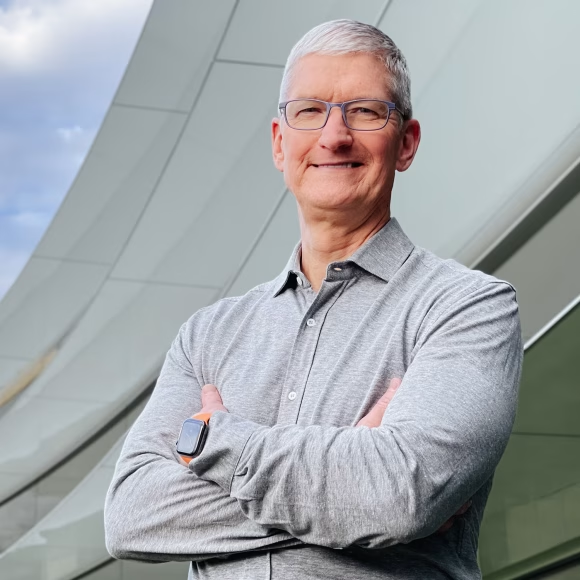
Timothy Donald Cook, the long-serving Chief Executive Officer of Apple, is set to step down from his role and hand over the reins to John Ternus on September 1, 2026. Marking the end of an era, Cook’s historic 15-year tenure as CEO represents a masterclass in exponential corporate growth and operational resilience. Rather than fading into retirement, Cook will transition into the role of Executive Chairman of the Board, allowing incoming CEO John Ternus, Apple’s current Senior Vice President of Hardware Engineering, to guide the tech giant into its next chapter.
The Early Years: Building the Supply Chain Mindset
Born on November 1, 1960 in Mobile, Alabama, Cook grew up in the rural town of Robertsdale. An academically driven student, he earned a Bachelor of Science in Industrial Engineering from Auburn University in 1982, followed by an MBA from Duke University’s Fuqua School of Business in 1988. These formative academic years deeply instilled the principles of industrial optimization and systemic problem-solving that would later redefine Apple’s corporate strategy.
The Corporate Glory
Right after earning his MBA, Cook spent 12 years at IBM, where he specialized in manufacturing and distribution. Rising to Director of North American Fulfillment, he mastered the just-in-time (JIT) manufacturing workflow, a strategy focused on absolute operational readiness while minimizing costly, stagnant warehouse inventory.
After a 12 year tenure at IBM, in 1994, he joined Intelligent Electronics as Chief Operating Officer (COO), managing corporate logistics and vendor relations. By 1997, he transitioned to Compaq Computer Corporation as the Vice President of Corporate Materials, charged with procuring and streamlining the company’s entire product inventory.
The Meeting That Saved Apple
In early 1998, a recently returned Steve Jobs was seeking a logistics expert to rescue Apple from the brink of bankruptcy. Despite Apple’s financial state at the time, a legendary five-minute interview with Jobs convinced Cook to leave his secure position at Compaq. In March 1998, Cook officially joined Apple as the Senior Vice President of Worldwide Operations.
Cook immediately revolutionized Apple’s broken supply chain. He systematically closed down inefficient, company-owned factories and transferred production to third-party contract manufacturers. By aggressively slashing on-hand inventory cycles from a full month down to a mere matter of days, Cook unlocked vital liquidity. This freed-up capital provided the financial foundation required to fund Apple’s upcoming hardware revolutions, including the iPod, iPhone, and iPad.
Building the Trillion-Dollar Ecosystem
When Cook became the CEO in 2011, he faced the daunting task of following a visionary founder. Instead of relying solely on entirely new product categories, he built out an interconnected ecosystem. Under his leadership, Apple successfully launched new hardware such as the Apple Watch and AirPods, and heavily expanded into high-margin services like Apple Music, iCloud, and Apple TV+. Furthermore, Cook insulated Apple from third-party vendor dependencies by successfully steering the company toward proprietary Apple Silicon (M-series chips), fundamentally altering the performance capabilities of the Mac and iPad lineups.
During his tenure, Apple’s valuation skyrocketed from roughly $350 billion to surpass $4 trillion, making it the first company ever to reach these milestones. Cook also oversaw the largest stock buyback program in corporate history.
The New Era Begins
Effective September 1, 2026, Cook’s 15-year run as Chief Executive will draw to a close as he steps into his new capacity as Executive Chairman. The chief executive baton passes to John Ternus, a 25-year Apple veteran and engineer by trade who has overseen the hardware engineering of the iPhone, Mac, and iPad portfolios. While Steve Jobs gave Apple its innovative soul, Tim Cook built the high-margin, hyper-efficient global empire that secured its future.
Muskan Singh


